
I've just had a go at the bouncy ball. I think it could have ended up better, as the squashing and deformation on it looks a bit off. I'm going to have another go at it later this week I think. It has still taught me a lot about keyframes and using the graph editor, so I can hopefully apply that when I re-do it.
After the story workshop today, I realised I need to re-think my story idea. Phil pointed out some mistakes and unpossiblities in my original story idea, which when I look back through it, seem quite obvious. I did like my original idea, but after hearing some of the feedback from the class, I've realised I can push it further and create a story that is much better suited to a 1 minute animation. Some of the ideas that were brought up for my topic I like the sound on and I will try and build on some of the ideas that came up.
One bit of advice which I'm definitely going to use is the allowance that Phil has given of using something similar to our objects. I'm going to swap the trampoline for a rubber dinghy, because it would be more appropoate for a lighthouse and more believable.
I'm hoping to have a final story idea by the end of the week, so I can crack on.


La Jetée is a French film from 1962 which tells the story of a man caught up in World War three, in which Paris is destroyed and a post-apocalyptic struggle takes place underground. The survivors decide that their future is desolate, so begin to experiment with time travel to fix the past or create a new future they do this by using the main character, not named, as a vessel and try to send him back to a time in his past using his memories.

This story took a while to grasp, as it was forced onto the audience quite quickly, though as it is only a short film, at about 30 minutes, the story telling has to be quick and contain a lot of information. The film was very unique in terms of it's production and style. The entire piece consisted of black and white photographs to tell the story, all in quick succession and with full narration. The film is, more of a illustrated narration, with a very strong male voice lead. The story's 'twist' ending I really enjoyed, which was a explanation of why the man's memory of the 'Jetee' or the pier was so strong, that he was remembering his own death, which hadn't happened yet.

I think I enjoyed this film quite a bit because it reminded me of early Sci-Fi, like HG Wells with a bizarre time-travel plot, the male narration was also very similar to War of the Worlds recording. There were also a few scenes which had some strange un-sensible muttering in the background, this added a very strange and eery feeling to the film, along with the strong creepy images.

Yesterday, Alan explained in a lot of detail the different types of Animation that are used as well as their history throughout film and cartoons. As part of our Introduction to Animation unit, he showed us the differences between these methods along with some examples of them in use. Our task this week, to keep us progressing with Maya, is to create a short Playblast of a animated ball being dropped from a height and bouncing to a stop.
Alan also showed us different methods of animating, explaining Pose to Pose animation, whereby the animators have a starting pose and a finishing pose, whilst improvising in the middle to make the transition. This is used in a lot of the original Disney films, such as the Lion King and can be seen as the characters are constantly in very powerful poses and positions.

There is also the 'Straight Ahead' method, where improvisation is relied on a lot more, simply animating the character without a clear finishing point, this can have it's advantages, such as there being more entertaining and detailed movement, but ultimately it can be unreliable in terms of timing and not precise. The example Alan showed us for this was a scene from the original Clash of the Titans.

There was also Rotoscoping / Motion Capture, which has been used more recently to create a realistic animation style, used in films such as 'The Polar Express and 'Beowulf.'
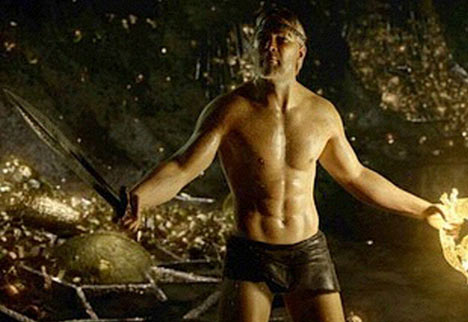
Though I think the main reason animation was used in this film was to prevent us having to look at the actual Ray Winstone in underwear, which would have been much more offensive.
The amount of information Alan gave us on Friday was huge that I will be re-reading over it over the next couple of weeks, I'm also going to have a crack and getting some of the books he showed us, though they do seem quite pricey. I think all of these fundamentals are going to be incredible important in the future.
As we're now in the realm of story-telling, I've been thinking about what I consider a good story to be. In today's lecture, Phil explained all of the different routes and structures a story can use, which I instantly recognised as being present in all of my favourites.
I read a lot and I always have a book handy, I know a lot of people don't like reading and prefer stories in different form (Films, Game etc.) but I've always preferred a novel. The main genre of book I've been reading over the last few years is Historical Fiction, which usually is a story within a historical plot. Most people refer to Bernard Cornwell as the king of the genre, and I completely agree. Cornwell is best-known for Sharpe, he has written over 20 books in the series and it was adapted for the BBC starring Sean Bean (and many lesser British actors spread throughout) I haven't made it through all of them, but I've read quite a few.


A series by Cornwell which I prefer is 'The Warlord Chronicles', it was written in the 1990s and consists of three novels. It takes place in Arthurian Britain, following a warrior under the command of 'King Arthur' named Derfel. The series follows King Arthur's 'knights' fighting off the Saxons from England. From any other Author, this plot may seem cliched and cheesy, but the realism and down-to-earth story which lays behind Cornwell's writing makes it seem very possible and amazing to read. Each battle is more brutal than the last, and it is soaked with historical fact (Though not much in this series, as it's all disputed)

The most recent series by Cornwell, which he is currently still writing is 'The Saxon Chronicles'. It is in it's 5th book (I think) and it follows 'Uhtred' a warrior in the 9th Century, a Saxon who was orphaned by a Viking horde and raised by them, pillaging and raping England for wealth. As he grows older, fate brings him back over to the side of the Saxons, clinging to the last piece of 'England' that has not been taken over by the Danish. He makes an oath to 'King Alfred' (Later Alfred the Great) to reclaim Southern England from the Vikings. The series is incredible, it is brutal and follows Uhtred 'Lord of Battles' as he fights the Danes.

This series, is based on historical events of that century, where the Danish held most of England's lands, with only the Kingdom of Wessex (Southern England, West of Kent) holding out against them, incredibly outnumbered. A quick excerpt to show the violence of the book:
Cenwulf and his men were behind me, and there we began the killing. The enemy ship was so loaded with men that they probably outnumbered us, but they were bone weary from a long day’s rowing, they had not expected an attack, and we were hungry for wealth. We had done this before and the crew was well trained, and they chopped their way down the boat, swords and axes swinging, and the sea was slopping over the side so that we waded through water as we clambered over the rowers’ benches. The water about our feet grew red. Some of our victims jumped overboard and clung to shattered oars in an attempt to escape us. One man, big bearded and wild eyed, came at us with a great sword and Eadric drove a spear into his chest and Leofric struck the man’s head with his axe, struck again, and blood sprayed up to the sail that was furled fore and aft on its long yard. The man sank to his knees and Eadric ground the spear deeper so that blood spilled down to the water. I half fell as a wave tilted the half-swamped ship. A man screamed and lunged a spear at me, I took it on my shield, knocked it aside and rammed Serpent-Breath at his face. He half fell, trying to escape the lunge, and I knocked him over the side with my shield’s heavy boss. I sensed movement to my right and swung Serpent-Breath like a reaping scythe and struck a woman in the head. She went down like a felled calf, a sword on her hand. I kicked the sword away and stamped on the woman’s belly. A child screamed and I shoved her aside, lunged at a man in a leather jerkin, raised my shield to block his axe blow and then spitted him on Serpent-Breath. The sword went deep into his belly, so deep that the blade stuck and I had to stand on him to tug it free.
There are plenty of other authors I like, Simon Scarrow being another great Historical-fiction writer along with Wilbur Smith. Cornwell has always been my favoruite author, and I suspect he always will be. I know these type of books aren't many people's cup of tea. When I try to explain to a friend or family member how great a certain book was I get a pitied look with a 'Sounds gruesome' or 'Thats nice, but I'm going to stick with this Auto-biography of Peter Kay'.
I'd love to hear what other people have been reading and what stories they consider to be 'perfect'.
I read a lot and I always have a book handy, I know a lot of people don't like reading and prefer stories in different form (Films, Game etc.) but I've always preferred a novel. The main genre of book I've been reading over the last few years is Historical Fiction, which usually is a story within a historical plot. Most people refer to Bernard Cornwell as the king of the genre, and I completely agree. Cornwell is best-known for Sharpe, he has written over 20 books in the series and it was adapted for the BBC starring Sean Bean (and many lesser British actors spread throughout) I haven't made it through all of them, but I've read quite a few.


A series by Cornwell which I prefer is 'The Warlord Chronicles', it was written in the 1990s and consists of three novels. It takes place in Arthurian Britain, following a warrior under the command of 'King Arthur' named Derfel. The series follows King Arthur's 'knights' fighting off the Saxons from England. From any other Author, this plot may seem cliched and cheesy, but the realism and down-to-earth story which lays behind Cornwell's writing makes it seem very possible and amazing to read. Each battle is more brutal than the last, and it is soaked with historical fact (Though not much in this series, as it's all disputed)

The most recent series by Cornwell, which he is currently still writing is 'The Saxon Chronicles'. It is in it's 5th book (I think) and it follows 'Uhtred' a warrior in the 9th Century, a Saxon who was orphaned by a Viking horde and raised by them, pillaging and raping England for wealth. As he grows older, fate brings him back over to the side of the Saxons, clinging to the last piece of 'England' that has not been taken over by the Danish. He makes an oath to 'King Alfred' (Later Alfred the Great) to reclaim Southern England from the Vikings. The series is incredible, it is brutal and follows Uhtred 'Lord of Battles' as he fights the Danes.
This series, is based on historical events of that century, where the Danish held most of England's lands, with only the Kingdom of Wessex (Southern England, West of Kent) holding out against them, incredibly outnumbered. A quick excerpt to show the violence of the book:
Cenwulf and his men were behind me, and there we began the killing. The enemy ship was so loaded with men that they probably outnumbered us, but they were bone weary from a long day’s rowing, they had not expected an attack, and we were hungry for wealth. We had done this before and the crew was well trained, and they chopped their way down the boat, swords and axes swinging, and the sea was slopping over the side so that we waded through water as we clambered over the rowers’ benches. The water about our feet grew red. Some of our victims jumped overboard and clung to shattered oars in an attempt to escape us. One man, big bearded and wild eyed, came at us with a great sword and Eadric drove a spear into his chest and Leofric struck the man’s head with his axe, struck again, and blood sprayed up to the sail that was furled fore and aft on its long yard. The man sank to his knees and Eadric ground the spear deeper so that blood spilled down to the water. I half fell as a wave tilted the half-swamped ship. A man screamed and lunged a spear at me, I took it on my shield, knocked it aside and rammed Serpent-Breath at his face. He half fell, trying to escape the lunge, and I knocked him over the side with my shield’s heavy boss. I sensed movement to my right and swung Serpent-Breath like a reaping scythe and struck a woman in the head. She went down like a felled calf, a sword on her hand. I kicked the sword away and stamped on the woman’s belly. A child screamed and I shoved her aside, lunged at a man in a leather jerkin, raised my shield to block his axe blow and then spitted him on Serpent-Breath. The sword went deep into his belly, so deep that the blade stuck and I had to stand on him to tug it free.
There are plenty of other authors I like, Simon Scarrow being another great Historical-fiction writer along with Wilbur Smith. Cornwell has always been my favoruite author, and I suspect he always will be. I know these type of books aren't many people's cup of tea. When I try to explain to a friend or family member how great a certain book was I get a pitied look with a 'Sounds gruesome' or 'Thats nice, but I'm going to stick with this Auto-biography of Peter Kay'.
I'd love to hear what other people have been reading and what stories they consider to be 'perfect'.
I've been thinking about my main character for the project, which I have already decided in my story, will be a ghostly boy. I was thinking about how I can make him more unique as a ghost, and rather than making him a sheet with legs, I would make him seem a more realistic ghost. I also wanted him to be a different era from the present, so I'm thinking of making him a victorian-dressed boy. I have started a sketch, but I want to refine his clothes, as well as work on his face. I want him to look a bit Oliver Twist. The other ghosts still need to be decided.
 Bit of visual research:


After this morning's briefing, I can tell this unit is going to be a tricky one, so I decided, like a lot of people I expect, to get cracking early. I've have a full story, with the three stages that I think incorporates all of my given objects well as well and has a good opportunity to be entertaining. I have written the story with all the current details in a long list of events, which I've posted below. As I do not have a scanner with me, it has been taken with a camera, but this weekend I'll scan everything paper in. I've typed the written ideas below so they are readable.

I've broken the story up into 10 parts. Parts 1-3 being the beginning, 3-7 being the middle and 7-10 being the end (This will probably change when I get feedback and alter the story)
1.
The story begins with a ghostly boy walking down a path in the daytime, he is on a country road,with no-one else around. He spots in the near distance, at the bottom of a hill, towards the coast, a rural lighthouse with a lighthouse keeper outside, walking towards it, on his way inside. The ghost stops and stares towards it.
2.
There is a flashback into the ghost boy's memory of where he was coming from: a graveyard, it shows him with three other boy ghosts, who look slightly older than him. One starts screaming and waving his arms and the others clap him, another ghost then points to the boy and he tries his best 'frightening' face, trying to look scary. All the other three ghosts point and laugh at him, making him feel useless and he runs out of the graveyard. It then cuts back to the ghost now, and he has a smirk on his face.
(At this point my goal is to have made the audience understand that the ghost is an 'outcast' for not being frightening enough, and doing what a ghost should do. Him running towards the lighthouse keeper I hope suggests that he is planning to scare him.)
3.
The ghost runs down a hill towards the lighthouse and follows the keeper inside the doorway.
4.
The ghost is following the lighthouse keeper up a spiral stairway inside the building, the keeper has a headstart, and is just walking up, the ghost is trying to catch up by running behind him. The ghost finally catches up, is right behind the keeper, as he opens a door off of the stairs. The ghost raises his arms, about to scream and scare him, when the keeper simply shuts a wooden door behind him, unknown to the ghost's presence, leaving the him outside on the staircase.
The lighthouse keeper is now in his living quarters, he sits down in a chair, with his back to the window and begins to read a book. Meanwhile, the ghost is trying to push the door open, but he is too weak and the door is just lightly rattling.
5.
The ghost soon gives up and is shown sitting outside the lighthouse looking frustrated. He looks at a seagull flying through the air, it lands on the lighthouse's window ledge up above. He smiles and gets up, his expression shows hope, as if he has an idea. He runs further away down the path, and then time passes.
6.
The next part, it is almost dusk and shows the ghost returning to the lighthouse, with a trampoline in tow. He is dragging it towards the ground under the window. Meanwhile, it shows the keeper look at his watch, get out of his chair and go over to the window, he is looking out to sea. As he turns around so hes no longer facing the window, the ghost bounces up and pulls a scary face, obviously, the keeper cannot see him, and leaves the room, going up towards the beacon. As he is leaving the room, the ghost continues bouncing, each time looking more annoyed. The ghost is shown getting off the trampoline and looking very frustrated as he cannot scare the keeper.
7.
Suddenly, the light on the beacon shines, as the keeper turns it on, the keeper is shown standing on the railing, looking out to sea, the ghost looks up at the beam, back to the trampoline and grins. He takes a run up, with a lot of effort him jumps on the trampoline and bounces right up infront of the beacon light. This projects him into the cloudy sky into a 100ft shadow of a ghost. The keeper obviously finally sees him, looks terrified, screams and runs back to his living quarters and hides in his room.
8.
The other three ghosts in the graveyard are then shown, looking into the sky at the huge figure, they look at each other really surprised and run in the direction of the beam.
9.
The small ghost stops bouncing, gets off of the trampline and is laughing really hard, he clapses against the side of the lighthouse and glances towards the hill. On the top of the hill, he sees the three ghosts coming towards him.
10.
The little ghost gets up and walks towards them, the nearer he gets, he sees they are all clapping him and one is whistling him with congratulations. He takes a bow and grin It ends showing the keeper hiding under his bed covers, whilst in the distance outside his window the four ghosts can be seen walking back over the hill towards the graveyard.
That was much longer than I thought although i'm confident that with some editing it can be condensed to a minute long, I'm sure i'll have received feedback after the workshop next week, which might even suggest I shorten it.
A few reference pictures to help visualise the story:


If anyone managed to read it, if you have anything that you think will improve it then i'll appreciate it.


