
- The visual style and animation techniques will be familiar to people this age, and they will be more interested in learning the information if it is in a dynamic and visually-pleasing way
- I can sum up the information in a moderate way, I will not need to research advanced Bio-Chemistry (Thank God) but at the same time I can include information that pupils of a younger age would not grasp.
- The animation will not need to be patronising, I can aim it directly at this year-range, assuming how much the viewer already understands.
- I did my GCSE's not that long ago and I believe I still have a good idea of what I wanted to see and how information was 'digested'.
I've decided on my target audience for my Fern animation. It will be targeted at Secondary School Pupils doing their GCSEs (14, 15 and 16 years old). It may also be useful for older students (I never knew anything about Ferns before yesterday, so It would have definitely educated me) I've decided on this for several reasons:


Fantastic Voyage is a Sci-Fi-adventure film produced 1966. It revolves around a team of scientists and doctors who shrink a medical team along with a submarine to microscopic size in order to inject them into another scientist's body to save his life. Although it is far-fetched, it does take a scientific approach and features plenty of scenes based around human anatomy including the ear, heart and brains. The film is not only constantly referenced for it's storyline, but the special effects that were used were groundbreaking. The visuals were very vivid and alomost psychedelic with bright colours floating around the ship.

It featured a couple of recognisable actors, Rachel Welch who starred in One Million Years B.C, a film which featured in my essay as Ray Harryhausen produced the effects. Another character that was familiar was the doctor played by Donald Pleasence, who played 'The Forger' in The Great Escape, which I watched last week for ideas on my drawn animation.
Edit: You know when you say a word so many times it stops making sense. Well Fern no longer makes sense. Yesterday I hadn't thought about Ferns for years, now I have typed this word hundreds of times and my brain has been ambushed. Better press on though
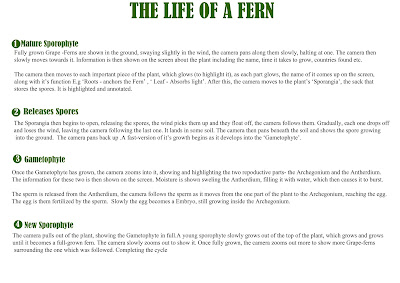
This is the first idea I've had for a narrative. It maybe too long, and there isn't enough scientific detail in it as of yet, but I think I'm getting some useful ideas down, so it's worth it for now. It's in an image so I can refer to it and change it around easily, rather than having a wall of text.

Quick Concept

This is the first idea I've had for a narrative. It maybe too long, and there isn't enough scientific detail in it as of yet, but I think I'm getting some useful ideas down, so it's worth it for now. It's in an image so I can refer to it and change it around easily, rather than having a wall of text.


Quick Concept

I've compiled a couple of different Fern cycles I've found (one of which was provided in the Brief) as well as microscopic photos of the plants into four-stage cycle, this allows my animation to be split up between these four parts, which lead on from each other. I've also found a fern which I'd like to base the animation around - The Sceptridium or the 'Grape Fern'. The reason for this is the almost Sci-Fi design of their spore pods, shown in the research.
Now that I've complied this, I completely understand the process and have a few ideas about how cinematic I can make certain parts. I also see where The Haploid and Diploid comes in, which I'll have to include in the animation.


Now that I've complied this, I completely understand the process and have a few ideas about how cinematic I can make certain parts. I also see where The Haploid and Diploid comes in, which I'll have to include in the animation.


After an incredibly informative and entertaining breifing this morning by our Commissioner, Peter Klappa I have chosen the topic for my animation: The Life of a Fern. The main reason I chose this is because I saw a lot of potential for CG in the cycle, such as the spores being released from pods and the plants sprouting from the earth. After a bit of research, I'm happy with my choice. I am going to resolve a narrative and begin my concepts this week, so I can produce as many 'convincers' as I can before the Pitch on the 10th.


Here are the rigging tutorials:
Character Rigging


Mechanical Leg

Tail Rig

Walk Cycle Mechanics
Character Rigging


Mechanical Leg

Blink
Tail Rig

Can Exchange
I understand the theory behind this one, but I still had a lot of problems with it. First Maya would crash when mirroring them, then my right arm is bending awkwardly (Which I think is something to do with the IK as I had to re-create it after not mirroring) next, the can seems a little off the hand, which I think might be a problem with the pivot, which I had a crack at fixing. I'm going to re-do this one to get it right.
Walk Cycle Mechanics
I've been looking through the online brief we received yesterday and also thinking about some of the information Phil told us. In two weeks time, May 10th , we have a Pitch presentation to our Commisioners, by this time we need a full grasp of what our final production will be along with all our pre-production. This includes our narrative with storyboarding (In animatic form), concept art and some Maya pre-visualisation, which seems about the same as the previous Story-telling unit, this gives a rough idea of how much time will need to be spent on these.

A major decision in this unit that Phil explained yesterday was the target audience, which can be anything from primary school children to undergraduates. The tone of the production will be based on who we choose to 'instruct'. I was thinking about this and depending on the further information we receive (what we're assigned) I think setting a target audience at GCSE level is a good choice. This way, the basics and important parts of the process can be explained but it will not be saturated with scientific information, neither will it be too simple. Also, creating this in a 3D animation allows it to be scenic, filmic and cinematic. Students at GCSE would have a better appreciation and understanding of this. Once we've been given the detailed brief I'll have to consider this.
As for the production, a lot of planning is going to be needed, taking into account render and editing times.


